
Share This Article
The Board of Corrections voted Monday to accept the Arkansas attorney general’s settlement offers requiring the panel to say laws taking away the panel’s ability to hire or fire top prison officials are constitutional and to state that board members violated open-records laws.
The settlements approved by a 4-3 vote could end a legal fight that began when the board sued Gov. Sarah Huckabee Sanders in 2023. The panel had challenged two state laws it argued weakened the board’s constitutional authority.
Attorney General Tim Griffin then sued the board, alleging it violated the Arkansas Freedom of Information Act when the panel hired a law firm to represent it in the lawsuit.
The settlement for the FOIA case requires the board to concede to three FOIA violations and commit to complying with the public records law in the future.

The settlement comes about three months after Sanders won a majority on the seven-member panel with whom she had clashed. All four of the members supporting the settlements are appointees of the governor.
The settlement for the board’s lawsuit requires the panel to agree that Acts 185 and 659 of 2023 are constitutional and do not violate Amendment 33 to the state constitution, according to a letter from the attorney general’s office.

Act 185 shifts authority over the corrections secretary from the board to the governor, while Act 659 requires the Division of Correction and Division of Community Correction directors to serve at the pleasure of the secretary instead of the board.
The board would also state that it illegally retained special counsel and that there were several procedural issues with the case.
The settlement in the board lawsuit will be effective only when the Arkansas Supreme Court reverses or vacates a circuit judge’s decision to permanently block the two laws after declaring them unconstitutional. Five of the seven justices on the court have Republican Party ties.
Dubs Byers, one of three members to vote against accepting the settlements, said he was concerned about reversing a legal decision that had already been upheld in court and diminishing authority granted to the corrections board by Amendment 33.
“This is not a routine decision, it’s a generational decision,” said Byers, who was appointed to the board by Republican Gov. Asa Hutchinson.
Approved by voters in 1942, Amendment 33 was the first in a series of amendments to protect certain government boards and agencies from political influence and decentralize the executive branch’s power.
Byers said accepting the settlement agreements raises “serious ethical concerns” because some board members have close ties to the offices involved in the lawsuits and they’re being asked to approve settlements “that overwhelmingly benefits those same offices.”
“I am not questioning motives, but I am questioning whether this structure creates the appearance and the reality of a process that circumvents the intent of the constitution,” Byers said.
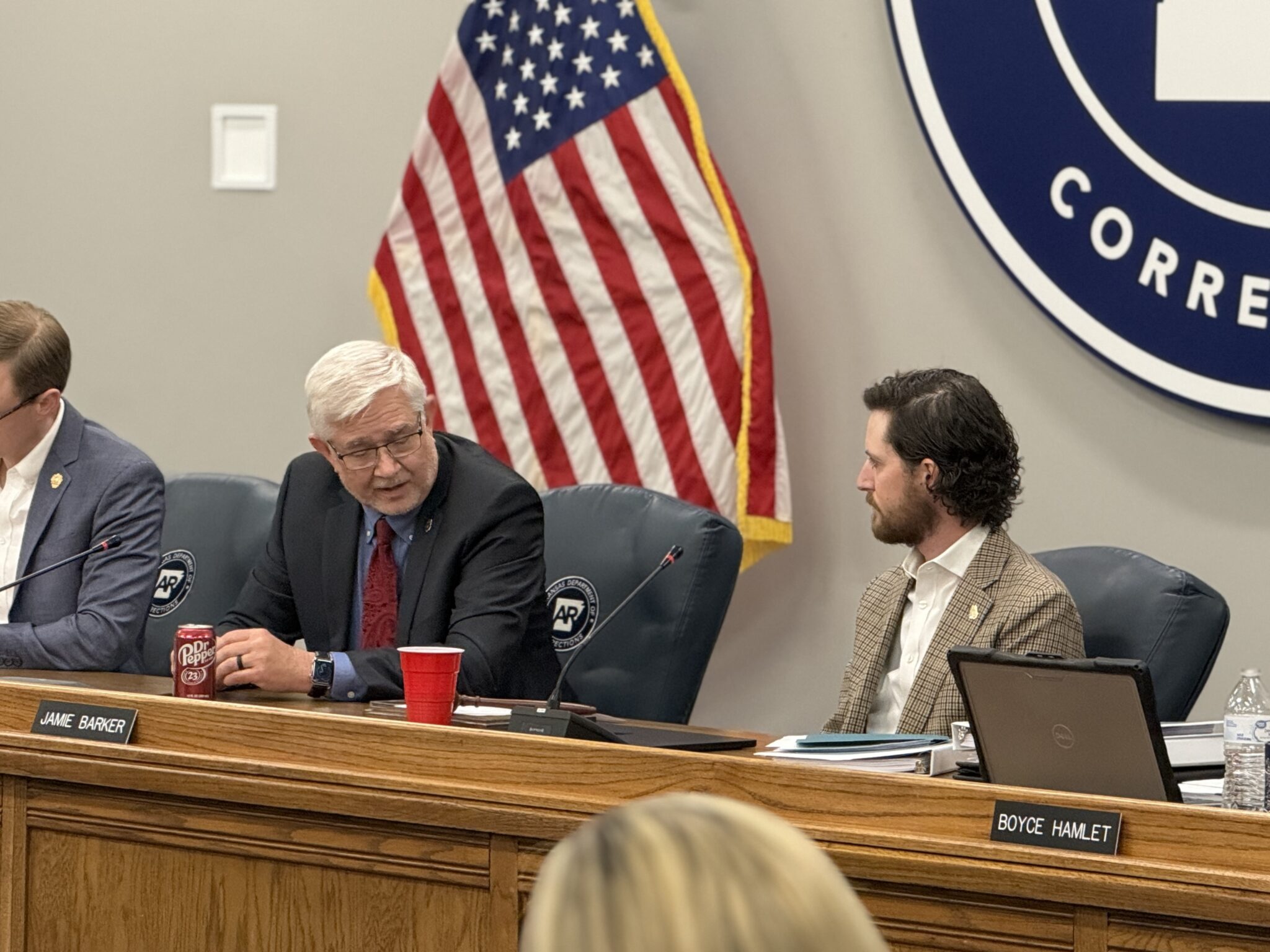
January marked the first time Sanders’ appointees held a majority on the seven-member board. At its regular meeting, the board voted Jamie Barker, Sanders’ appointee and former deputy chief of staff, its chair. Within two hours of becoming chair, Barker called a special meeting to rescind the hiring of Abtin Mehdizadegan and his law firm in litigation against the governor.
At Monday’s meeting, Barker and Sanders appointee Nathan Lee said accepting the attorney general’s settlement agreements was the best decision for the corrections board.
“I think that would be in the board’s best interest and the state,” Lee said. “I’m kind of looking forward to getting all the litigation behind us so that we can just get into the business of supporting and advocating for the Department of Corrections.”
Boyce Hamlet, a former special agent in the attorney general’s office, and former state lawmaker Grant Hodges also voted to accept the settlements.
In a statement released prior to Monday’s meeting, board member Lee Watson said it was “improper and unethical” for the attorney general to propose a settlement to the board, which has not yet hired new legal counsel.
Thomas Burns, a staff attorney employed by the board, has said in legal filings he is unable to represent the board himself.
Watson, an attorney who joined Byers and Alonza Jiles in voting against accepting the settlements, earlier this month said he wanted to represent himself in the FOIA lawsuit. Watson and former chairman Benny Magness are named in the attorney general’s settlement agreement.
Hutchinson appointed Watson and Jiles to the board.
Regarding the board’s suit against the state, Watson said Monday that the Arkansas Supreme Court should be allowed to rule on its constitutionality because its decision would have a “far-reaching impact” beyond the corrections board to other constitutionally created boards.
“That’s why we’re independent, so that we’re free from that political influence,” Watson said. “And that’s what Amendment 33 is all about is inappropriate and overreaching political influence.”
Arkansas Advocate is part of States Newsroom, a network of news bureaus supported by grants and a coalition of donors as a 501c(3) public charity. Arkansas Advocate maintains editorial independence. This article was published with permission from the Arkansas Advocate. Contact Editor Andrew DeMillo for questions: [email protected]. Follow Arkansas Advocate on Facebook and Twitter.
