

Share This Article
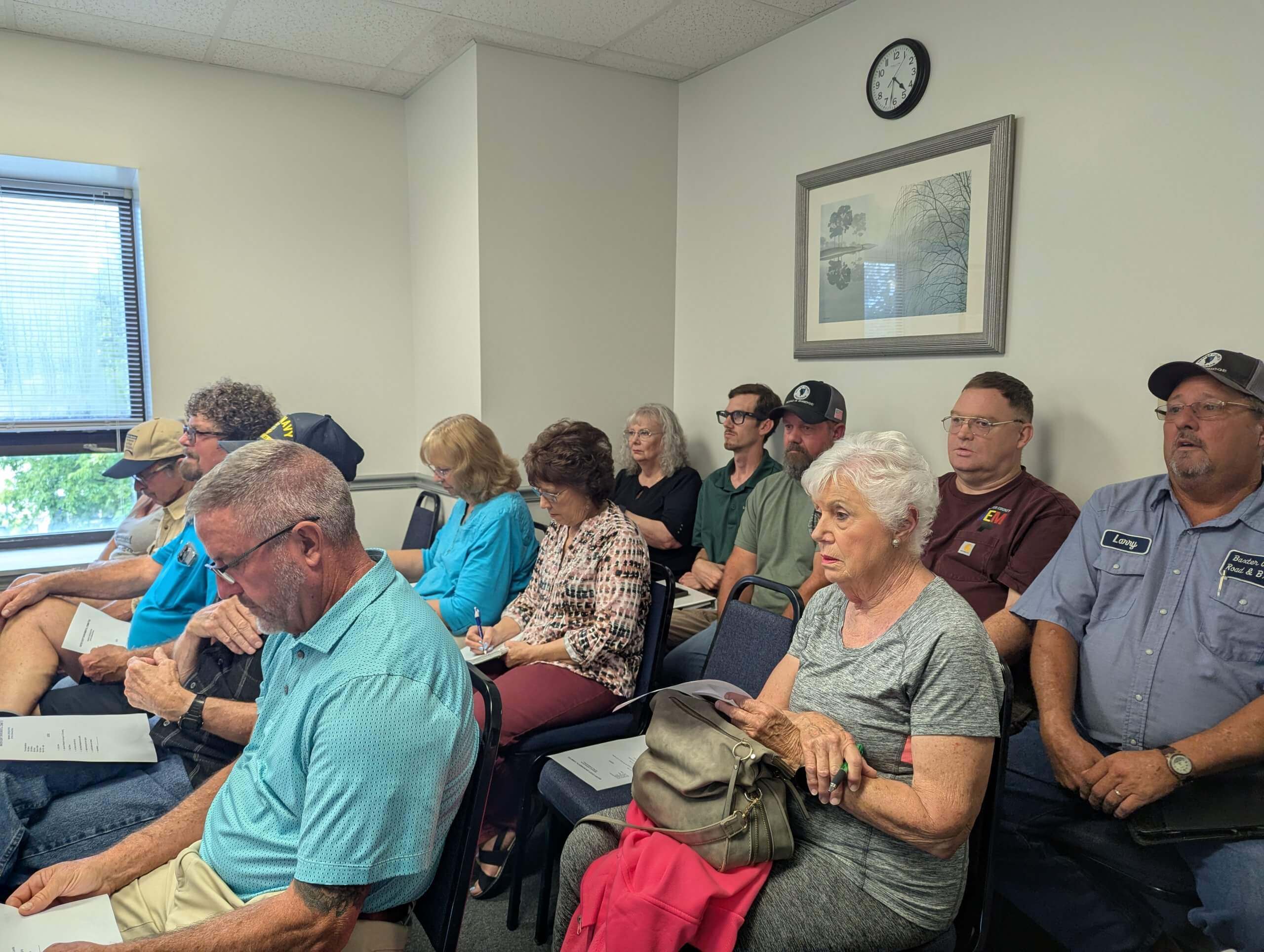
The Baxter County Environmental Committee convened Tuesday afternoon for the first time in 12 years, immediately electing Justice of the Peace Bob Nault as chairman before launching into heated discussions about controversial activities at an old quarry site that had sparked community outrage on social media.
The 4:30 p.m. meeting opened with Judge Kevin Litty suggesting the group could move to the courtroom if more space was needed. After electing officers, Nault directed discussion to air quality and open burning issues at the quarry off Highway 5.
Litty began by stating the county was “permitted through ADEQ” to burn at the site, presenting what he initially called a permit but was actually an agreement with North Arkansas Electric Cooperative.
“We have written documentation, an agreement with North Arkansas Electric which we hold. We don’t burn a lot. We hadn’t burned down there until two or three weeks ago, and before that it was since the tornado.”
When asked about the difference between this and tornado debris disposal from last year’s storms, Litty explained that tornado debris required detailed documentation for FEMA reimbursement, though he couldn’t recall the exact number of loads processed.

Nault mentioned complaints he’d received, including photos showing what appeared to be trash mixed with brush.

“I circled that pile of brush before it was burned. I wasn’t looking for trash and I didn’t see trash, but I’m not going to say there wasn’t trash,” Litty responded.
He then made a revealing admission about historical problems at the site.
“After talking with these guys, some things that’s gone on in the past at the quarry, we put a stop to some of it. I didn’t realize a lot of it was going on because it’s gone on for maybe 15, 20, 25 years. I didn’t give permission for something to go on, but we stopped some of it since I found out.”
County Prosecuting Attorney David Ethredge clarified the legal framework, explaining the county judge could operate facilities “as long as it complies with the law,” whether through ordinances passed by the quorum court or state statutes.
When pressed for specific permit documentation, one resident insisted on seeing more details.
“The permit will have requirements and conditions and compliance requirements. I want to see that kind of detail.”
Jim Baker, whose property borders the quarry and who was one of only two residents to call Litty directly with complaints, challenged the entire arrangement with the electric company.
“In the past, this has never been done before. I’ve lived here all my life and worked for the electric company. They’ve ground it in the past so it turned into compost, wasn’t getting burned. Now we’ve changed it, we’re hauling it in and burning it.”
Baker questioned the financial logic of the arrangement.
“This is costing county money. The county has to spend money to tend to it, the residents around it put up with smoke from it, and it was working great before. Why are we trying to redo this?”
He pressed further on the issue.
“The electric company gets paid for what they do. They’ve dealt with it through the years by having it ground. Why are we putting ourselves in this jeopardy of disposing for them?”
Litty and Baker then had a back and forth over the county getting involved in the tree clearing business. The reaction to the discussion was mixed with some residents complaining about the deal and others pointing out that NAEC provides electricity to over 20,000 residents in the county and that tree clearing was beneficial to residents in Baxter County.
The discussion then pivoted and intensified when water contamination concerns arose. An unnamed friend of Baker’s provided dramatic testimony about changes at Baker’s property.

“I was working in that area doing some timber work on Mr. Baker’s property, not employed by him, just a longtime friend. It was pretty hot this summer, so water is a pretty big deal. I couldn’t believe the taste and how fresh and nice the water was out of the well sitting on the shop right against the quarry. It’s almost like watermelon, you know, a sweet, good taste in water.”
The man said he had asked Baker for permission to take some home.
“I said, ‘Do you mind if I get a few jugs to take home? Because I got city water and I don’t like city water, I don’t like chlorine.’ He said, ‘You get all you want. This is a good well, it’s always been a good well.’ I can’t believe how sparkling it is and clear.”
But after what locals called “the incident” at the quarry, everything changed.
“I saw the water in the same jug. I wouldn’t give it to the hogs. There’s something drastically did change, and it wasn’t one rain or two, it just changed, and it was directly after the incident of the quarry.”
When Litty asked what incident he meant, the man revealed what he’d witnessed.
“When I passed El Chico’s and went ‘Wow, they’re tearing that down,’ I found out that material was being hauled to that quarry.”
“No, it’s not,” Litty interrupted.
Baker then explained what actually caused the contamination.
“A couple hydro-excavation trucks from [inaudible] construction would come down, dump water out, then put gray water back in. That’s what muddied the quarry.”
“That’s what muddied my well, and that’s what muddied my other one,” Baker continued.
His well at 175 feet was affected immediately, while another at 839 feet “muddied one week later.”
Baker expressed serious health concerns about the trucks.
“The trucks were used for septic services prior to that, and it could spread E. coli. That’s not good. We don’t ever need to go there again.”
“We shouldn’t have ever gone there,” Baker emphasized.
Litty responded that he had acted immediately upon learning of the problem.
“I was unaware that there were some blower trucks dumping out there. I put a stop to it the day after I found out.”
The conversation turned to the area’s broader water problems. Litty defended the quarry by explaining he’d done extensive research.
“I talked to real estate agents, I checked with pump guys, I’ve checked with well guys. The real estate guys say there’s many, many homes on both sides of Highway 5 in that area with muddy wells, single, double, triple filtered to try to get water.”
Justice of the Peace Lisa House, who owns Kinetico Water Systems, confirmed widespread contamination issues in the region.
“I probably sell a chlorinator a month for E. coli and coliform bacteria,” she said, covering a 100-mile radius. “There’s contamination everywhere. My best customers are all down Five South because it’s all mud, clay mud, filthy water.”
Litty provided another example of the area’s water problems.
“I got a friend that lives out Highway 5 on the left side of the highway. His water, you can’t even smell it. Been like it for years. Smells like rotten eggs.”
Baker acknowledged the quarry’s history but insisted his situation was different.
“The quarry was shut down because of mud vein in 2000,” he said.
But his well had been fine after he “put a liner in that well and put pea gravel all the way around that liner” until the recent truck dumping.
“It’s a delicate situation where we just don’t need any hydro-excavation trucks in there anymore.”
The El Chico’s confusion was finally clarified when Litty explained his reversal.
“We were going to because my first professional opinion that I thought I had said we could haul parts of it, not all of it. We had a second opinion because of public outcry. Second opinion recommended we take nothing there, so we took nothing.”
“But you thought we took something. We didn’t take a drop of anything,” Litty insisted. “None of that material from El Chico’s went to the quarry. It went to the landfill, checked by ADEQ, recorded.”
To alleviate future security concerns about dumping and burning at the quarry, Litty announced a $15,000 investment in electronic gates.
“Everybody’s going to have what they call a fob to get in and out. We’ll assign them, and when they scan it, they’ll check in and out. If I give one to someone for two weeks to work with North Arkansas Electric, and I see Bob down there checking in with it, we’re going to have a problem.”
Litty presented water test results showing the quarry water was safe.
“We checked every box they offered. It cost us a couple hundred bucks to get that done, but I did it just to show people that our water in the quarry is good. It’s got living fish in it.”
Baker’s friend complained about the air quality from the burning.
“There’s something more than wood burning in that fire because I fly in that area and I’m extremely sensitive. I quit cigarettes about 50 years ago, and I can smell one 500 yards off.”
Litty made a promise about future burning.
“That pile’s gone and I’ll make sure there’s nothing in the next pile that gets burned other than timber.”
As the meeting wound down, committee members clarified solid waste laws.
“You cannot bury two-by-fours, sheetrock, insulation and so forth,” Nault explained. “Anything man-made cannot be buried. It has to go to a Class 1 to Class 4 landfill.”
A brief discussion was had over reclaiming the quarry, which would cost the county millions to do, before Nault wrapped up the meeting.
“If we can get this under control where it doesn’t happen again, we don’t dump muddy water from hydros, everything, would that make everybody happy?”
The meeting then concluded with residents requesting copies of water tests and permits, which Litty promised would be available through County Treasurer Christy Hoffman’s office.
“Come by and get one. We got a brand new five thousand dollar copy machine sitting right there. We’ll make copies all day long if they show up.”
“I want what’s best for Baxter County, and I’ll do what’s best,” Litty said. “We’ll do our best to protect our property and protect the citizens around it.”

