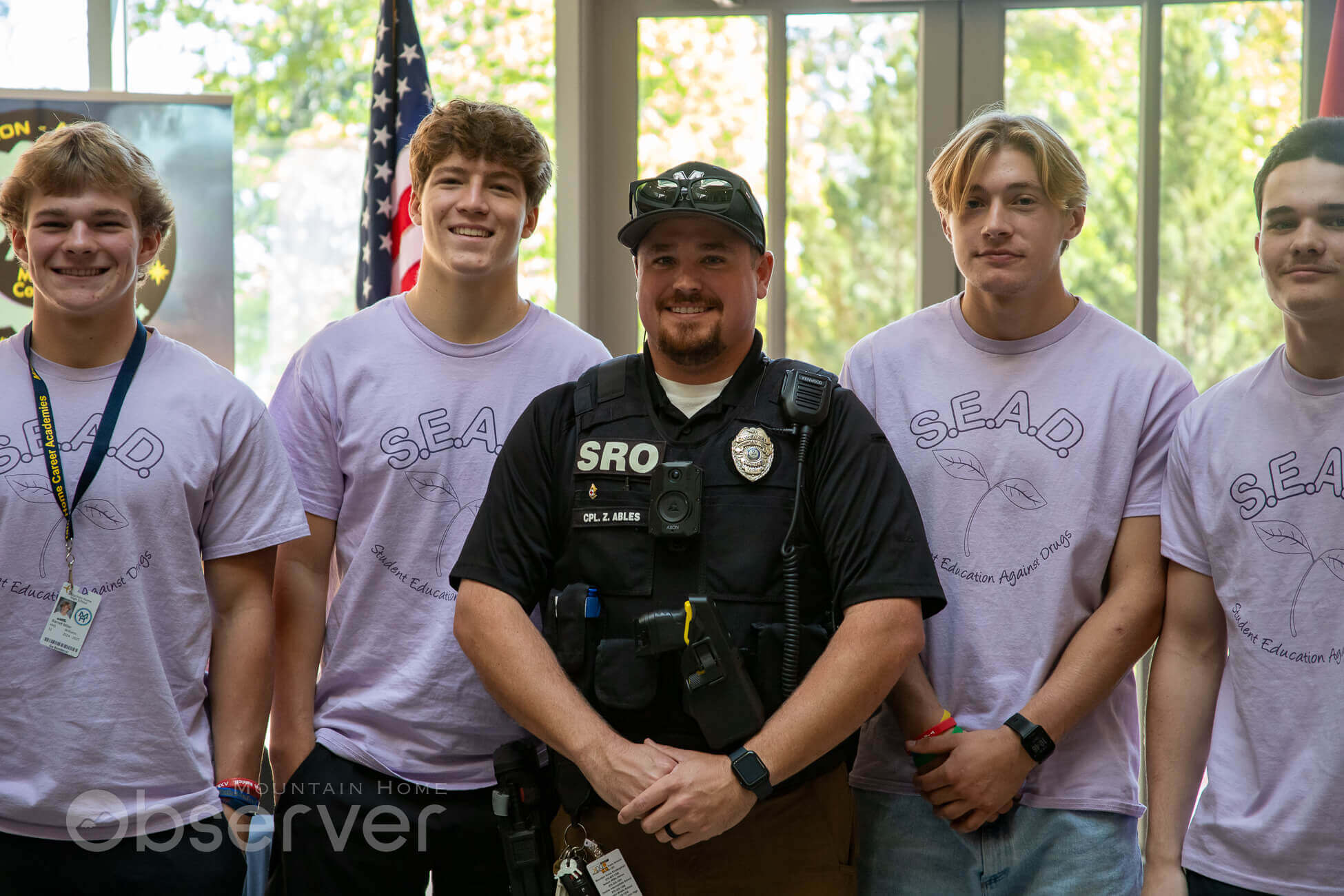
It was a big day for residents who have taken up the fight against substance abuse in the Twin Lakes Area.
During a press conference at ASU-Mountain Home, the Prevention Awareness for Youth Support (PAYS) Coalition announced they had been awarded a $625,000 federal grant to combat youth substance abuse in Baxter and Marion counties.
The Drug Free Communities (DFC) Support Program grant will provide $125,000 annually for five years, bolstering local efforts to prevent youth substance misuse in the region. The funding will enable ASUMH to hire a full-time DFC coordinator who will work closely with the coalition and the SEAD clubs to implement prevention programs across the two counties.
“It is such an exciting day, a culmination of events that were put into motion a really long time ago,” said Dr. Bentley Wallace, Chancellor of ASUMH, during the press conference held at the Vada Sheid Community Development Center.

“About 18 months ago, in the Spring of 23, Carry came with his group to the college and met with the team here and told the story of what we can do in our community to support awareness and protect children in our area from substance abuse. And the college agreed to be the fiscal agent, the partner through which any grant funds that were secured could be spent on this initiative and the college was happy to do it.”
Following Dr. Wallace’s opening comments, Mountain Home City Councilman and former Mountain Home Police Chief Carry Manuel, a key figure in the PAYS Coalition, took to the microphone to describe the two-year grant application process that saw volunteers dedicating hours of their free time to getting the training needed to qualify for the grant.

“It’s been a two-year and eight-month process,” Manuel said. “And during that process, there’s been a lot of work done, there’s been a lot of meetings, there’s been a lot of training and so on and so forth and partnerships that were built.”
“I want to thank Cheryl Green, Sherri Hinrichs and Kyle Evatts for their vision to get together and see if there was something we can do in Baxter and Marion counties to help with substance issues and abuse. And out of that meeting, I believe in Jan. 2022, this is the ending result of that initial meeting.”
Manuel detailed the coalition’s journey, which began with a state-level grant.

“We were looking at it in the DFC grant and our plans were to make that application in April last year which I believe around April the 30th, it would be the deadline. But during this process, we became aware of a state agency, ARORP (Arkansas Opioid Recovery Partnership) that they had money to give coalitions, and you had to apply for it. So that it would be solely used for the purpose of setting the coalition up to apply for the DFC grant.”
This initial grant, called the Coalition Empowerment (COPE) funding, provided $25,000 to prepare for the DFC grant application. Manuel emphasized the importance of this step.
“We applied to that Grant and it’s a COPE grant Coalition empowerment funding. To do just that task. Twenty-five thousand dollars was the grant awarded, and we began the process of meeting milestones during that time,” Manuel said
These milestones included attending conferences and training sessions in other parts of the country.
“That would include attending a mid-year conference in Dallas Texas. A national conference in Washington D.C, put on and trained by CADCA –I just got to say it’s a fantastic organization. It was a requirement that we be a part of that in the grant process and we are, but they delivered tons of information for us.”
Manuel and other members of PAYS were also required to attend opioid abuse training which spanned 12 days over three months. The former police chief noted that Arkansas is the only state in the country that sends people to CADCA training before awarding them the grant.
Manuel highlighted the competitive nature of the grant process and the coalition’s commitment to the community, noting that only seven grants were awarded this year, with five of them, roughly $4 million in federal funding, going towards counties in Northern Arkansas.
“We’re going to be impactful when we serve our youth in this area. We’re going to be relentless in delivering prevention and awareness programs to our youth. We’re going to be good stewards of our funding and we’re going to be mindful of our shortfalls and quickly make appropriate adjustments as needed as we serve our community.”

Manuel thanked Cheryl Green, director of the 14th Judicial District Circuit Court Juvenile Division, for her help in recommending Leslie Gable to assist in writing the grant application, as well as convincing the state to change their budget to allow for the expenditure of hiring Gable out of the initial $25,000 that was given to PAYS.
Manuel ended his speech by saying PAYS and ASUMH “were going to kick it up into high gear with this funding” before introducing Mountain Home High School Assistant Principal Steve Morris to discuss the Student Education Against Drugs (SEAD) club, which is set to be the cornerstone of PAYS vision for preventing substance abuse in children.
“We want to make sure that we reduce this use of substances among our youth,” Manuel said. “Hopefully along the way, I think we will undoubtedly save lives by doing this and by improving our communities with less abuse, we think we can increase the quality of lives for the people who have had to suffer from addiction.
During his speech, Morris reported a surge in student interest and outlined the club’s objectives.
“The first program we had 20 to 25 kids last year,” Morris said. “We had a club fair at Mountain Home High School at the first of September and we had 79 students sign up – and we’ve been telling our kids since day one there’s no telling where this club can go. They have a huge horizon ahead of it.”

According to Morris, SEAD got its start two years ago after Cheryl Green reached out and asked if any students were interested in what PAYS was trying to do. Six students answered that call and began the work of creating the SEAD club, while also getting the training needed to teach other students about substance abuse while in school. And while three of those students have moved on to college, the newly formed club they left behind helped PAYS secure their most recent grant.
“I think the biggest reason why we received this grant is, as we were going along in this process, this journey, we were already doing the things that we put on paper,” Morris said. “We didn’t have to say what we were going to do, we said we are currently doing this, and I think that set us ahead and made us stand out above the competition for this grant.”
After the conference, Morris took the time to talk about the substance abuse issues going on in the Mountain Home School District, noting that vaping had become the go-to drug of choice for students at his school.
Vaping took off in the late 2000s and has continued to develop over the years. It has grown immensely popular with young adults due to the various flavors available on the open market. While most use vaping as a replacement for cigarettes, vaping has also evolved to use other drugs such as weed and meth.
The average age of nicotine initiation for minors in Arkansas is 13 years of age according to the Arkansas Department of Health. In Arkansas, the percentage of high school students who use e-cigarettes is now more than double the percentage of high school students who smoke.

The Campaign for Tobacco Free Kids currently tracks 7,900 students, or 4.9%, in the state who smoke cigarettes. E-cigarettes are currently being used at a rate of 19.6% amongst the state’s students.
Only 18.7% of adults smoke in Arkansas.
A potential health side effect of vaping is “popcorn lung,” a serious lung disease that causes coughing, wheezing and shortness of breath, similar to the symptoms of chronic obstructive pulmonary disease (COPD). The name comes from a past chemical that was used in microwavable popcorn to give it a buttery flavor.
That chemical was banned for commercial food use by the US government over a decade ago after employees working in a popcorn factory began to become sick after breathing the chemical in.
The chemical can still be found in the poorer quality e-juices that are used on the market for vaping. Other common substances found in e-liquid or produced when it’s heated up may also pose a risk to the lungs.
These include:
- Diacetyl: This food additive, used to deepen e-cigarette flavors, is known to damage small passageways in the lungs.
- Formaldehyde: This toxic chemical can cause lung disease and contribute to heart disease.
- Acrolein: Most often used as a weed killer, this chemical can also damage the lungs.
Advocates for vaping claim that vaping is not addictive and is healthier than smoking traditional cancer-causing cigarettes.
According to the Arkansas Prevention Needs Assessment (APNA) 2022-2023 survey, 92.9% of youth in Baxter County reported not participating in any prevention programs or seeing any prevention messages in school or the community.

While vaping is a major concern, Baxter County is also well known for its opioid pandemic.
The Arkansas Department of Human Services and the University of Arkansas Criminal Justice Institute currently rank Baxter County for adverse childhood experiences, depressive disorders, youth perception of harm, and drug poisoning mortality.
The prescribing rate for opioid prescriptions is 133.4 per 100 residents each year. Roughly 55,168 opioid prescriptions are written each year, outpacing the county’s 41,355 residents.
After Morris finished his speech, he introduced Zane Darraq, a senior at Mountain Home High School and one of the original SEAD members, who highlighted the club’s rapid growth and outreach efforts.
“The original six members of SEAD Club, we got contacted by Mr. Morris and we went to a PAYS Coalition, one of their monthly meetings and during that meeting, we were given the opportunity to create a club. So, we put our big brains together and decided a name for our club and a name that really struck us with SEAD Club or SEAD Club– students educated against drugs. From that, the next year that six grew to 25 members. And 25 members might not seem like a lot but in Mountain Home, there have been clubs that have been out there for way longer than SEAD Club and they don’t have 25 members.”

Darraq continued, “As of now this year we have 79 members of SEAD club and out of those 79, 50 are trained on how to impact kids, how to build a relationship and how to teach kids about vaping and other harmful drugs.”
The impact of SEAD’s youth-led efforts extends beyond Mountain Home. Elizabeth Smith, a SEAD member from Yellville-Summit High School, stressed the importance of their work.
“There are so many people in this world who can be affected by drugs, and I just think it’s so important that we come together as a community and as a group and we work to prevent the usage, especially in young children. So, one thing that we’ve done through SEAD, is we put on a huge Community Health Fair. We have a blood drive. We have groups who talk about healthy eating, we have groups who talk about medicine and how to get Medicare and all these kinds of things.”
Smith continued by highlighting the need to get into the classroom and educate children about drug use.
“We need to be in the classrooms with them. We need to be right in front of them, and so, we’ve taken the initiative to be with these kids and to educate them and to teach them,” Smith said.

Attendees at yesterday’s press conference included representatives from local law enforcement, such as Marion County Sheriff Greg Alexander and Mountain Home Police Chief Eddie Griffin, as well as Baxter County Judge Kevin Litty and Mountain Home Mayor Hillrey Adams.
The PAYS Coalition’s success is the result of collaborative efforts from various community members and organizations. Other contributors to this effort include Mountain Home SRO Officer Zach Ables, Kylie Andrews, Anna Cantrell, Pam Catlin, Janie Davidson, Monica Green, Jamie Hardin, Lockie Jones, Marie Thompson, Jennifer Veloria-Dunn, the Fraternal Order of Police, Kiwanis Club of Mountain Home, Mountain Home Citizens Police Academy Alumni Association, ASU Mountain Home, Dr. Bentley Wallace, and CADCA.
“It’s a long-term strategy to change the culture at the community level environmental policy changes, school-based youth activities,” said Sherri Hinrichs. “Over time the goal is to reduce and eliminate substance misuse.”
Photo Gallery: