

Share This Article
The head of Arkansas’s wholesale power provider told local cooperative members last Thursday that the state’s electric cooperatives should build 1,850 megawatts of new natural gas generation by 2030, claiming it’s the only viable option to replace coal plants being closed after an environmental lawsuit.
Arkansas Electric Cooperative Corporation CEO Buddy Hasten made the case for natural gas during North Arkansas Electric Cooperative’s annual meeting in Salem, arguing that renewable energy and nuclear power cannot adequately replace the power his cooperatives purchase from two Entergy-owned coal plants scheduled for closure.
The White Bluff Power Plant near Redfield must stop coal combustion by the end of 2028, while the Independence Power Plant must close by 2030 under a settlement agreement approved by a federal judge in 2021. Environmental groups, including the Sierra Club, successfully sued Entergy for Clean Air Act violations, forcing the closures.
The White Bluff plant received a two-year exemption from revised air pollution rules under a Trump administration rollback of environmental standards adopted last year. The exemption allows the plant to avoid installing new pollution control equipment before its scheduled closure, raising concerns from environmental groups about prolonged exposure to unhealthy emissions.
While Entergy owns and operates the plants, AECC purchases power from them through long-term agreements to supply Arkansas’s 17 electric cooperatives. The closures will eliminate 1,168 megawatts of generation capacity that AECC relies on.
“The reality is it’s going to cost more,” Hasten told cooperative members, using a pickup truck analogy to explain the expensive transition: “If you looked out your driveway and you had a 2010 F-150, it works just fine. If you wanted to do the same exact job with a 2025 brand new F-150, which one is going to cost you more to own and operate?”

Hasten’s push for natural gas contrasts with Entergy’s approach. As part of the 2021 settlement, Entergy agreed to pursue 800 megawatts of renewable energy through the Arkansas Public Service Commission by 2027. Environmental groups praised the settlement, saying it would save customers billions while increasing renewable energy investment.
But Hasten argued last Thursday that renewables cannot reliably meet Arkansas’s power needs, especially as the state has become winter-peaking with demand hitting 3,300 megawatts in winter compared to 2,632 megawatts in summer.
“We’ve got to have the new 2025 truck. I don’t want it. I was happy with the 2010. It works just fine,” Hasten said. “But I’m being told I can’t have the 2010 pickup anymore.”
Hasten’s Case Against Renewables
The AECC chief, a former nuclear submarine commander, argued that renewable energy sources cannot reliably meet Arkansas’s power needs, citing capacity factor limitations.
Solar panels produce power at full capacity only 24% of the time when averaged across all hours of the year, while wind turbines fare slightly better at 35%, according to Hasten. But he said regional grid operators drastically discount their reliability value.
“If I build a 100 megawatt solar array, in the summertime I will get four percent credit for that,” Hasten said. “In the winter, which is my limiting factor, I build a hundred, I get two. You cannot build yourself to success that way.”
This directly contradicts the environmental groups’ position from the 2021 settlement. Glen Hooks, the Sierra Club’s Arkansas Chapter director, said at the time that “replacing electric capacity with renewable energy and energy efficiency is the cleanest, safest and most affordable way for Entergy Arkansas to power its customers.”
Nuclear power, while reliable, is economically unfeasible according to Hasten’s analysis. He pointed to the recently completed Vogtle nuclear plant in Georgia, which cost $36 billion for two reactors—$16,000 per kilowatt of capacity compared to roughly $1,500 per kilowatt for natural gas plants.
Rising Costs and Rate Impact
Hasten emphasized that the transition comes as equipment costs have skyrocketed. He cited large power transformers increasing 40% in two years, circuit breakers jumping 50%, and gas turbines more than doubling in price.
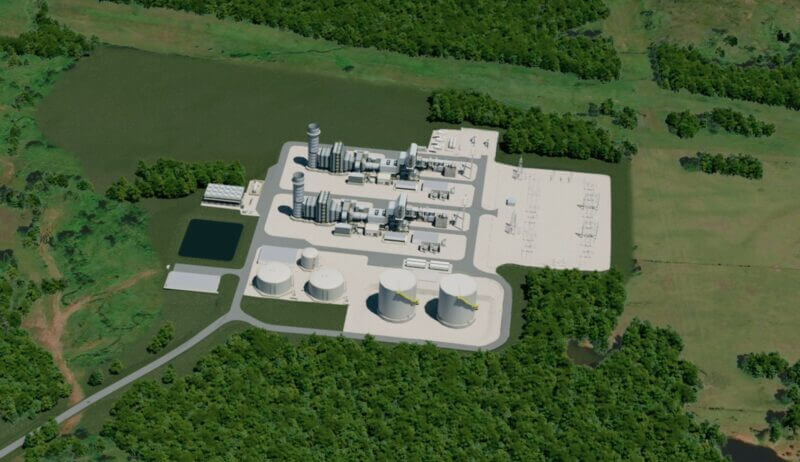
AECC has already begun implementing Hasten’s vision, with two 100-megawatt gas turbines coming online this year. A larger facility in Texas will add 850 megawatts in 2028. The final piece—a 1,350-megawatt combined cycle plant in Arkansas—is planned for one of the retiring coal plant sites by 2030.
“When we go to buy these power plants, and we’re already writing checks, those checks are going to add up to three billion dollars,” Hasten said.
The infrastructure costs from Hasten’s plan would flow directly to the 600,000 meters served by Arkansas’s 17 electric cooperatives, affecting 1.2 million residents across two-thirds of the state’s land area.
AECC implemented a 3% wholesale rate increase this year to begin building reserves for the transition. That increase was passed through to cooperative members like those at North Arkansas Electric, which added its own 9.4% increase for local system needs.
“This rate increase that we put in this year wasn’t just to pay the bills,” Hasten explained. “It was to generate higher margins for AECC so that we can bank those margins because when we go to buy these power plants… the banker is not going to give us money if we do not have enough equity.”
Environmental Impact
The coal plants scheduled for closure rank among the nation’s worst polluters. According to 2018 data cited in the Entergy lawsuit, they ranked in the top 10 for harmful sulfur-dioxide emissions and top 40 for nitrogen-oxide emissions out of more than 1,300 U.S. power plants.
Environmental advocates argued the closures would benefit communities from St. Louis to Memphis and protect natural areas, including the Buffalo National River and Caney Creek Wilderness.
Hasten characterized the situation as “a forced transition from coal to gas by federal regulation” and focused his presentation on replacement capacity needs, costs, and reliability concerns.
Data Center Pressure
Complicating Hasten’s transition plans, AECC faces unprecedented demand for new electric service. He said data centers and artificial intelligence facilities are seeking 4,000 megawatts of new connections—more than the cooperative’s entire current peak load of 3,300 megawatts.
“It took us 80 years to get this big, and now there are people that want us to get twice as big in two years,” Hasten said.
He warned that a single Bitcoin transaction consumes as much electricity as 523,000 Visa transactions, while mining one Bitcoin uses as much power as an average home consumes in a month. AI searches use 10 times more electricity than traditional Google searches.
Arkansas’s lithium extraction industry, tapping the Smackover Formation, could add 50 to 250 megawatts of demand if fully developed, Hasten noted.
The state legislature passed Act 373 to help utilities manage the growth, allowing special rate contracts and construction aid for large customers. But Hasten warned about balancing new opportunities with existing member needs.
“How do we separate off if we do add some of that new load? How do we separate that cost from our existing members?” he asked. “It can’t be done perfectly.”
Despite the challenges, Hasten noted that Arkansas maintains some of the nation’s lowest electric rates. AECC charged an average of $60.83 per megawatt hour in 2024, compared to the national average of $72 for generation and transmission cooperatives.
“My goal for my team is how do we, when 2031 comes, how do we remain eighth in the country on the cost of wholesale power,” Hasten said. “All boats are going to rise in America, I promise you. But how do we not rise higher than the rest?”
The divergent approaches between Entergy’s renewable energy commitments and AECC’s natural gas plans highlight the ongoing debate over how Arkansas will replace its aging coal infrastructure while maintaining reliable and affordable electricity service.

