

Share This Article
A couple had originally planned to rent an Airbnb outside of Conway for a month. When the rental fell through, they started looking online, found a photo of Norfork Lake and booked a stay instead. After a month, they asked if they could stay longer. Then they asked again.
Chamber President Dani Pugsley told that story at the organization’s Feb. 10 breakfast at ASU-Mountain Home to illustrate a point she wanted the room to understand: tourism is not just about weekend visitors. It is the front door to everything else, relocation, construction, small business growth and long-term economic development.
“Every time people come to Mountain Home, it’s introducing people to our community,” Pugsley said.
The numbers bear that out. According to the 2024 Arkansas Tourism Economic Impact Report, visitors spent approximately $218 million in Baxter County last year, generating $350 million in total business sales and supporting roughly 2,200 local jobs. Out of 75 Arkansas counties, Baxter County ranks 10th in tourism revenue.
Visitor spending flows first into food and beverage, then transportation and fuel, then lodging, a distribution that Pugsley said demonstrates tourism’s reach beyond hotels and resorts into the broader business community.
“Tourism doesn’t just benefit our hotels,” she said. “It’s supporting our small businesses across the community.”

The data behind the visitors
Pugsley has increasingly relied on Placer, a mobile analytics platform that tracks visitor movement and spending patterns through cell phone data, to understand who is coming, where they are coming from and how long they are staying.
In 2024, Baxter County recorded nearly 450,000 overnight trips totaling 1.2 million visitor nights. In 2025, overnight trips dipped to 418,000, though total visitor nights held steady at around 1.2 million.
Pugsley said the slight decline is consistent with national trends and not cause for alarm on its own, but worth watching.
The data shows the average visitor is spending three to four days in the area, a sign that the Twin Lakes region is functioning as a destination rather than a stopover. The strongest feeder markets are within a two- to four-hour drive: Northwest Arkansas, Little Rock, Memphis, Springfield and St. Louis.
“Drive markets are more consistent,” Pugsley said. “They return more frequently.”
She said the Chamber is using that data to target social media advertising in those specific markets. In March, she will travel to the Ideal Living Show in Chicago at the invitation of the Arkansas Department of Parks, Heritage and Tourism to represent Mountain Home alongside two other Arkansas communities, promoting the area for both tourism and relocation.
Why they come, and what keeps them away
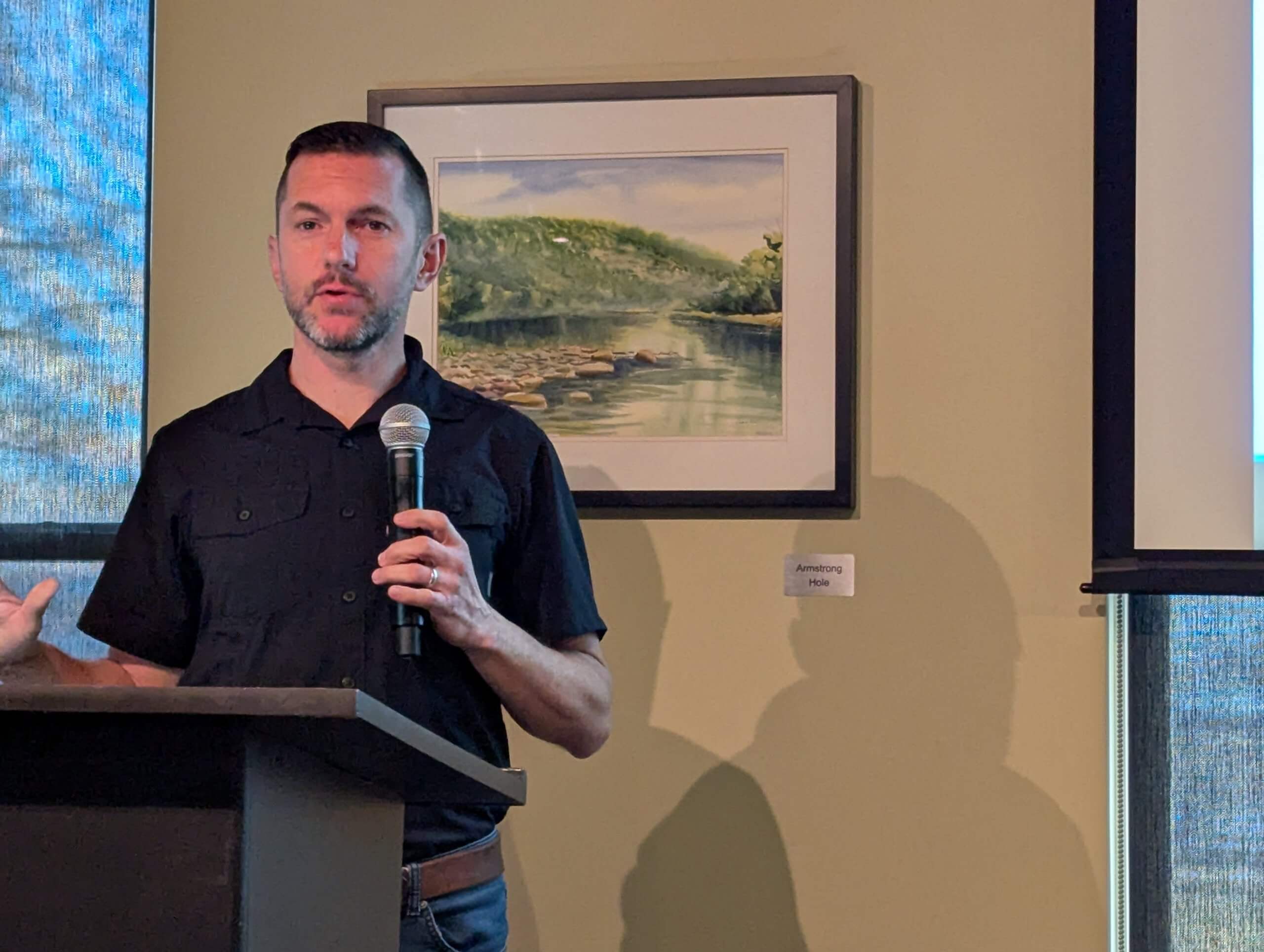
Matthew Leiboult, who owns the White Buffalo Resort in Buffalo City and co-owns the Blue Heron Campground near the Highway 62 bridge, has spent eight years listening to visitors explain why they chose the Twin Lakes area, and why some of them decide to stay.
“The natural beauty of north central Arkansas is the biggest thing that draws people here,” Leiboult said.
After that, he listed low cost of living, low population density, abundant outdoor recreation and the variety of views that come with the Ozarks’ topography, where hilltops, valleys and lake vistas can be found without driving an hour out of town.
He said trout fishing, in particular, draws visitors from as far as a 10-hour radius, pulling anglers from Chicago, Nashville, Dallas and Houston.
“You have to go far out west to find something that mimics what we have here,” Leiboult said of the fishery. “I can’t stress how unique and how special it is.”
But he was candid about what works against the area. Weather is the biggest variable. Last April’s near-daily rain suppressed bookings and kept visitors from renting boats or booking float trips. Economic uncertainty has tightened wallets, pushing visitors toward shorter, less expensive trips rather than canceling altogether.
And then there are the challenges that Leiboult said the community can actually influence.
He pointed to lake levels that leave marina parking lots underwater for five or six months a year, making it difficult for lake businesses to operate at full capacity. He called on local, state and federal representatives to push the U.S. Army Corps of Engineers to reconsider how it manages lake levels, acknowledging the dams were built for power generation and flood control but arguing that the priorities set decades ago may no longer reflect the region’s economic reality.
“The Corps of Engineers has made it very clear that tourism is not a priority for them,” Leiboult said. “While that is true, I would also suggest that was a long time ago.”
He called for better alignment among the Corps, U.S. Fish and Wildlife Service, Arkansas Game and Fish Commission and the Southwestern Power Administration, arguing that the financial impact of tourism in north central Arkansas deserves consideration alongside those agencies’ existing mandates.
Reinvestment as survival
Leiboult also delivered a pointed message to business owners in the tourism industry: stop relying on nostalgia.
He said many mom-and-pop resorts in the area have not reinvested in their properties, leaving guests uncertain whether they have walked into 1965 or 2026. Some returning customers stay loyal out of childhood memories, he said, but a business cannot grow on sentiment alone.
“We can’t rely on those fond memories to keep our business moving forward,” Leiboult said. “We have to be reinvesting.”
He said the same principle applies to restaurants and retail. The development Mountain Home has seen over the past five years is vital, he said, but the goal is not to turn the community into another Jonesboro or Fayetteville. It is to remain relevant.
“If there’s not reinvestment into our local economy, eventually we’ll become obsolete,” he said.
An overlooked asset
During the question-and-answer period, Gerald Gage of the Baxter County Airport made the case that the area’s aviation infrastructure is an underused tourism tool.
Gage said the airport averages 32 landings per day, a mix of tourists, business travelers and local recreational pilots. He cited state studies showing up to $9 million in annual economic impact from the airport and said the fixed-base operator, Bear Air, provides free crew cars for pilots flying in for the day along with rental cars for longer stays.
Leiboult agreed that getting word out about ground transportation from the airport would help resorts communicate options to visitors flying in from across the country.
“That’s certainly a big concern when you’re flying into the middle of nowhere,” Leiboult said. “What’s my ability to get from the airport to where I need to be?”
Pugsley said the Chamber’s fifth breakfast event, the first of 2026, continues to grow in attendance. She encouraged business owners to provide marketing materials for the Chicago trip in March.
Tourism economic impact reports for all Arkansas counties are available at adpht.arkansas.gov.

