


Talk about having a good time!
Veterans from all over Baxter County poured into ASU-Mountain Home’s campus this past Saturday to participate in Mountain Home’s Disabled American Veterans (DAV) Chapter 30’s 19th Annual Veterans Outreach and Appreciation Picnic.
And while past picnic’s have seen their fair share of people, this year’s picnic was one for the books, with record attendance from the county’s veterans.
The event, which ran from 11 a.m. to 1 p.m., opened with a color guard presentation by cadets with the Mountain Home NJROTC program and a prayer by Matt Shimmel of the Mountain Home Flyers Wrestling Club.
The picnic featured entertainment by the Katie Laney Project, Tim Tibbs, and Scott Ramos, along with a variety of vendors offering veteran-specific services. Mountain Home Public Schools’ students volunteered to serve meals throughout the event.

This year’s annual picnic was held in memory of Max Rainey, an Army veteran who served in the Vietnam War. Both he and his wife, Sharon Rainey, were beloved members of the Mountain Home veteran community and hosted an annual Rainey Remembers Vietnam event at the Elks Lodge in Mountain Home every year.

Mr. Rainey passed away on July 20th of this year. He was preceded by his wife who passed in August of 2020. Mr. Rainey’s burial will be held in Enid, Oklahoma.
Before the picnic’s festivities kicked off, Dr. Michael Moore, Interim Medical Center Director for the Department of Veterans Affairs, addressed the crowd and urged local veterans to take advantage of the veteran services that were being offered at the picnic.
“If you’re a veteran and not enrolled in VA Healthcare, today is your day,” said Moore. “We’re also able to get you your veteran ID card if you don’t already have one or would like a new one. We have a lot of our services here as well. It’s a good time to go ahead and get your flu shot, your COVID shot if you would like that.”

At the picnic, Moore also announced that the VA would be conducting toxic chemical screenings for veterans for the first time and urged those in the crowd to use the service. Moore credited the PACT Act with allowing the VA to be able to conduct toxic screenings.
“Many of you know about the PACT Act and its ability to expand services for veterans exposed to toxic chemicals from things they may have come into contact with while in the service,” Moore said. “We’re doing toxic exposure screenings today, so if you served and you’ve not had one of those, let me highly encourage you to go get that screening.”
Following the opening ceremony, Dan Hall, Commander of DAV Chapter 30, spoke to the Observer about the organization’s ongoing efforts to combat veteran suicide in Baxter County. Hall revealed that their initiatives have yielded significant results, with veteran suicide rates dropping dramatically in recent years.
“Suicide prevention has been our big focus here for the last six or eight years,” Hall said. “We’ve had real success here. We were invited by the VA to participate with the Together With Veterans rural grant program for suicide prevention and actually became a nationwide leader in our program and are often called to make several presentations around the country.”
On lowering suicide rates for local veterans, Hall said that it’s not an overnight process and that obtaining accurate data on veteran suicides is difficult.
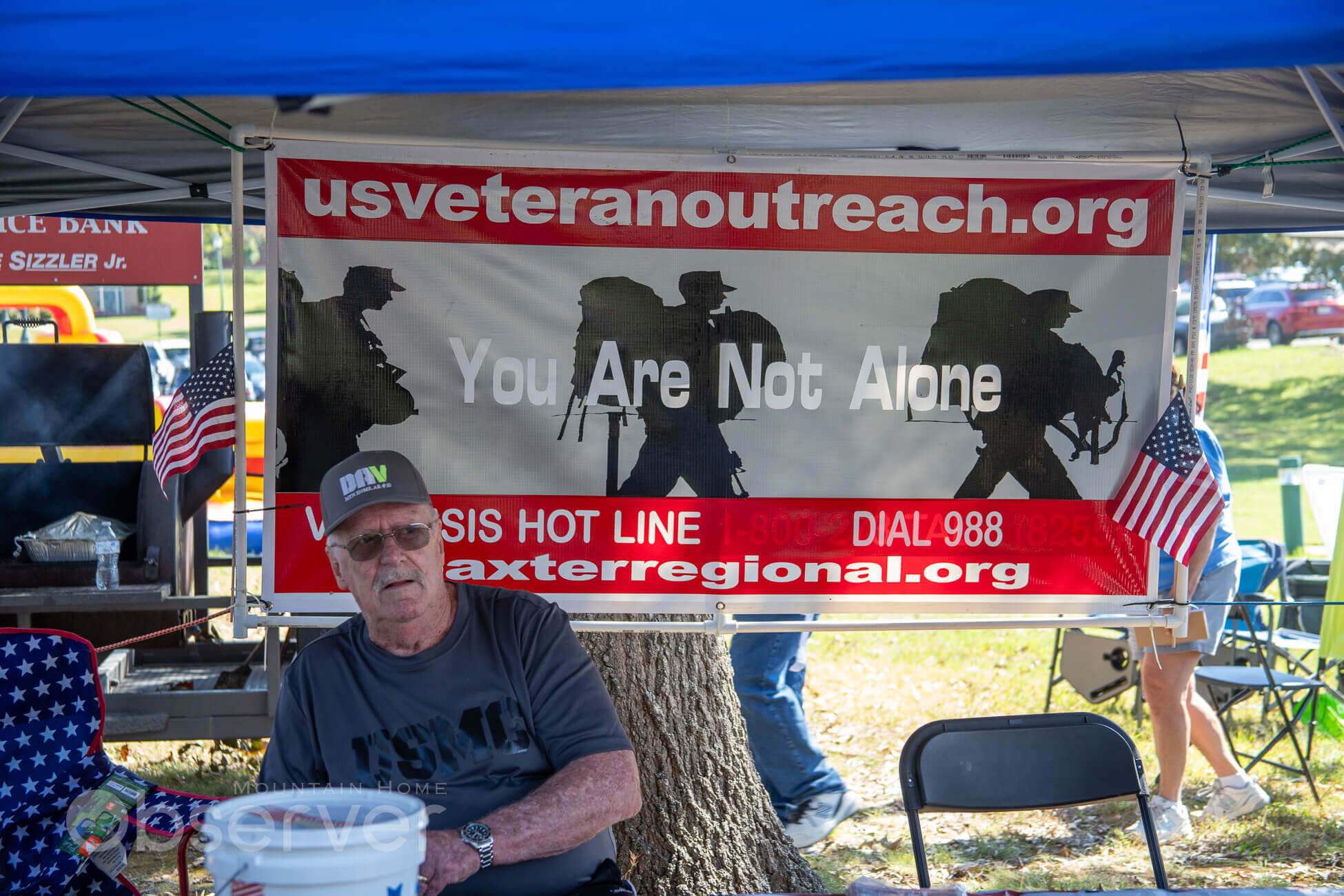
“The big problem that you have with ups and downs is the numbers aren’t accurate,” he said. “Anything you get from the VA or CDC is three years old. And it’s statistical data that doesn’t always ring true for your area.”
To combat this, Hall said DAV Chapter 30 has been working closely with Baxter County Coroner Brad Hays, who has gone above and beyond to train his staff to identify veterans if a suicide does occur in the county. On average Baxter County sees around two suicides per month.
“Brad Hays is our county coroner. He’s been a real partner in this. He’s done a good job of training his people to go to that extra step to identify veteran versus non-veteran suicide,” Hall explained.
This collaboration has led to more accurate local data, allowing for better-targeted interventions. Hall added, “We started to track how many we contact, how many we refer, how many actually sign up for VA care. And that number goes up, then we track the actual count on the coroner, and as those self-initiated contacts with services goes up, suicides come down.”
As the event wrapped up, Hall looked ahead to next year’s 20th anniversary picnic, reflecting on the progress made and the work still to be done.
“Next year’s going to be our twentieth year, and I’m already trying to think of what we’re going to do for the 20th anniversary,” Hall said.
Photo Gallery:


